
Understanding SWR
Standing Wave Ratio (SWR), sometimes called Voltage Standing Wave Ratio (VSWR), is one of the most commonly measured and least understood parameters in amateur radio.
Forward and Reflected Power
When you transmit:
- Forward power is the RF energy traveling from the transmitter toward the antenna.
- Reflected power is the RF energy being reflected from the antenna system back towards the transmitter.
A measurement for this forward and reflected power is the Standing Wave Ratio (SWR) and it describes how well the impedance of your antenna system matches the impedance of your feed line, usually 50 Ω in ham setups. A perfect match (1:1 SWR) means all forward power is absorbed by the antenna system, while higher ratios indicate some of the power is reflected back toward the transmitter.
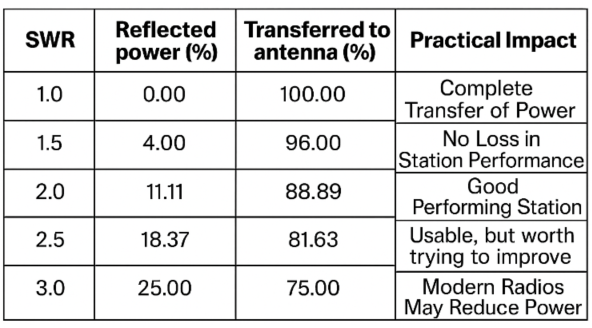
Because SWR meters are inexpensive, easy to use, and high SWR numbers can indicate a problem with the antenna system, many amateurs become fixated on achieving a perfect 1:1 SWR. This obsession is misplaced: anything below 2:1 is totally acceptable for most amateur applications, and even when SWR is higher than this the amount of the Reflected Power may not be as problematic as many people think.
Reflected Power and Power Transferred to Antenna
(Feedline Length can change these figures)
Where Does Power Go?
Reflected Power doesn’t disappear! Basic physics, more specifically the Law of Conservation of Energy, states energy cannot be created or destroyed, but that it can change forms. So, what then happens to the power?
- Some of it is Radiated by the antenna.
- Some is Reflected back towards the radio where it is then re-launched by the transmitter as Forward Power and back out to the antenna system. What doesn’t get radiated by the antenna on the second go around is reflected back towards the radio again, and this results in back and forth pattern repeating itself again and again until the system reaches equilibrium and there is no power left. With every back and forth cycle more and more of the reflected power is transferred into the antenna system.
- Every time power makes a trip up or down the feedline, some power is transformed into heat and dissipated by the feedline. The most commonly used feedline is coax so that is what is referenced here in this article, but ladder-line is another common choice of feedline because it has virtually no loss. For every back and forth trip RF takes, there is more power loss, but the loss is happening in the feedline not in the antenna’s high SWR! The shorter your coax run, the better the quality of your feedline, and the lower your operating frequency, the less power will be lost through heat transformation in the feedline.
To virtually eliminate feedline loss you could use balanced ladder-line instead of un-balanced coax, but the problem with ladder-line is that it has to be kept 12-24 inches away from conductive objects, which prevents it from being used in most applications. The SWR on ladder-line can be very high, but it doesn't matter because the loss in ladder-line is extremely low and an antenna tuner in the shack will fix the SWR.
Stop being hyper-focused on antenna SWR, and instead figure out how much power is being lost in your feedline for the particular frequencies you are operating on! You will likely be surprised by what you discover!
- With a SWR greater than about 3:1 most modern radios automatically reduce their power output. The radios do this in order to protect their finals from damage caused by high voltage or currents at the PA output. The high voltage or current at the PA output is the result of a resistive load impedance outside of the needed range of 33 to 100 Ω. An exorbitantly high SWR can be problematic, but SWR isn’t everything and Hams have devices such as Matching Units to prevent high SWRs from wreaking havoc.
How Much Power Is Lost?
As stated above, it depends on not only the SWR, but also on the length of the coax run, the quality of the feedline, and the operating frequency. Every time the power travels back and forth across the transmission line either as Reflected Power or Forward power, some of the power is transformed into heat and dissipates from the coax.
Given these factors lets look at two scenarios, both using RG8X coax and VHF frequencies. Scenario, one is a Mobile install having a short 10 foot coax run and a high SWR of 3:1, and the second scenario is a Base Station install having a long coax run of 100 feet and an acceptable but elevated SWR of 2:1. The commonly held belief is that the mobile install with a 3:1 SWR would perform very poorly, but if we look at the numbers in the chart below we can see it performs rather well with only 1.74 dB of loss and 67% of the power being successfully transferred to the antenna system. The Base station scenario however performs quite poorly even though it has a better SWR. Only 36% of its power is transferred to the antenna system. The poor performance of the Base Station is due in large part to the coax, not the SWR!
Coax Loss & SWR Comparison: Mobile vs. Base Installation
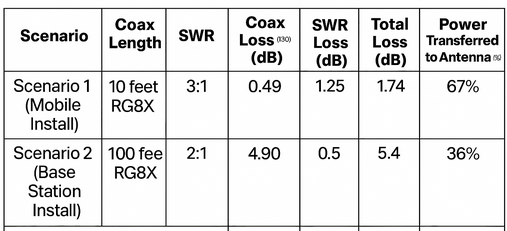
A power transfer of 36% sounds horrific, but if we will look at how many “S-Units” a loss of 5.4 dB is, and how this affects the quality of the signal it may not be as bad as it seems. Most radios these days have a signal strength meter which indicates how strong a received signal is. Ham radio operators use these strength meters to provide signal reports to transmitting stations. There are typically 9 bars on a signal strength meter. A report of 9 indicates full strength and a 1 indicates a very weak signal. Each bar, or S-Unit, represents 6 dB. Yes, you read that right, the 5.4 dB loss with only 36% of power being transferred to the antenna system equates to a mere one S-Unit difference, which is practically nothing!
Antenna Is Everything
Power transferred to the antenna system may be significantly less important than the antenna itself. What the antenna does with the power makes all the difference in the world. Think of a "Dummy Load" for a minute. A Dummy Load is a device designed to present a radio with a 50 Ω load and a perfect 1:1 SWR, but instead of efficiently radiating the power like an antenna it transforms most of the RF power into heat. Dummy Loads are most commonly used on test benches for situations in which you want to have your radio transmit but you do not want your signal to radiate out and cause interference to others. Some antennas act more like a dummy load than an antenna. Think about a one inch "stubby antenna" on a Handy Talkie. These one inch devices are marketed as antennas, but they are essentially a dummy load. Sure it radiates and receives signals, but it does so extremely inefficiently. Acting in a similar manner, devices sold as Dummy Loads radiate at least some RF. There is no such thing as a perfect Dummy Load which transforms all of RF into heat.
By applying these "Dummy Load" and radiation pattern principals to antenna efficiency, you can begin to see how much antennas and their radiation patterns can affect signal propagation. Simply transferring power to an antenna system with a perfect 1:1 SWR doesn't ensure your signal is getting out. For instance, in the scenarios above, the Base Station even with significant power loss could far out-perform the Mobile station if connected to a highly elevated and high gain base station antenna. Similarly, the mobile station, even with a high 3:1 SWR and 1.74dB signal loss, if paired with a Comet CA-2X4SR antenna, which has 3.8dB gain could come out ahead with an effective radiated power of 158%. In contrast, pair the mobile station with a poorly positioned small 13.8" NR72BC antenna, and your radiation pattern and the amount of power transferred to heat in the antenna might be so poor that you can't talk with a station a mile away.
A word from Jim W6LG
Here is a link to a short 10 minute video about this topic from well respected Elmer and Silent Key Jim Heath W6LG:
Key Takeaways
- Don’t obsess over 1:1 SWR. Anything below 2:1 is fine for most amateur setups.
- Energy is conserved. Reflected power is eventually transferred to the antenna system or becomes heat in the coax.
- Antenna or Dummy Load? Power transferred to an antenna is either radiated or becomes heat in the antenna system.
- Transceiver protection matters. Modern rigs reduce power when SWR is dangerously high, typically at around a 3:1 SWR.
- Efficiency depends on more than SWR. Antenna design, antenna position, coax length, and feedline quality often matter more than squeezing SWR down from 1.5 to 1:1.
In short, SWR is a diagnostic tool, not a performance guarantee. A perfect 1:1 match doesn’t measure antenna performance or how efficient the radiation is. A modest mismatch doesn’t doom your signal, and a high SWR doesn’t burn up power. Instead of fixating on SWR, your attention would be far better spent focusing on antenna system effectiveness, purchasing low-loss high quality feed-line, and creating a station that meets your practical needs. For a more complete understanding of this topic and understanding antenna system effectiveness we will soon be writing the article 'Antenna System Effectiveness' as the article 'Impedance Mismatch & Antenna Tuners". Check back in about a month or two for these upcoming articles!